

Businesses Requirements
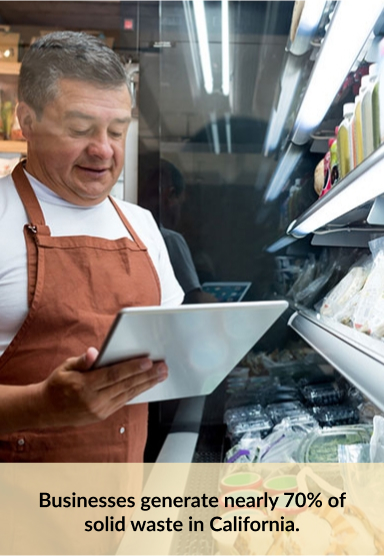

THESE REQUIREMENTS APPLY TO ALL FOR-PROFIT AND NON-PROFIT BUSINESSES, INCLUDING GOVERNMENT OFFICES, AND INDUSTRIAL FACILITIES.
- Must subscribe to an organic waste collection service in addition to garbage and recycling through a franchised hauling company for your area.
- May self-haul their materials and must ensure organic waste and recyclables are not landfilled, and receipts and weight tickets are kept on file. If your business self-manages any part of your organic waste, such as through self-hauling, backyard composting, or back-hauling, you will be required to register and submit information to Los Angeles County Public Works to ensure compliance.
- Provide an adequate number of organic waste and recycling containers to employees, contractors, tenants, and customers.
- Educate your tenants and staff on how to separate organic waste and recyclables from garbage.
- Containers for organic waste and recyclables must be provided in all areas where garbage containers are present, except for restrooms, or inside multi-family dwelling units.
- Containers must have labels with language and/or graphic images so employees or tenants can indicate primary materials accepted and prohibited by your hauler.
- Inspect containers periodically to make sure the right materials are going in the right containers.
- Businesses may apply for a temporary waiver and be exempt from some or all of the requirements, if they can provide adequate documentation and evidence to support one of the waiver options. More details coming soon.
Click here for more information on the unincorporated County commercial services.
Resources
Frequently Asked Questions
I operate a restaurant, what do I need to do to comply?
Food service providers must donate their excess edible food to a food recovery organization (ex: food bank, food pantry) to prevent food waste, and subscribe to organic waste collection service through your waste hauler or self-manage organic waste by self-hauling or managing on-site composting.
How should I dispose of food waste and how do I prevent it from smelling bad?
Options to dispose of food waste and reduce odors are:
- Line your container with readily available organic material such as newspaper, to absorb odor causing liquids.
- Clean your container frequently and keep your container in a dark and cool area.
- Additional ideas may be provided by your organic waste hauler for how to store your food scraps prior to placing them in the green cart or bin they provide.
Is my food establishment required to provide waste bins for customers?
Commercial food establishments that sell products meant for immediate consumption are required to provide bins to customers for collecting organic waste, recyclables, and trash.
Full-Service restaurants* do not need to provide labeled containers for customers but must provide them for employees to separate post-consumer waste.
All three (3) bins must be accessible, visible, and marked with clear instructions on what items are acceptable and prohibited.
Can I or my business be held liable for the food that I donate?
No. The Bill Emerson Good Samaritan Food Donation Act protects donors from liability and encourages the donation of suitable food and grocery products to nonprofit organizations for distribution to needy individuals.
How can I find out if my current waste services provided best match my needs?
For businesses located in Los Angeles County unincorporated communities, our waste hauler should have conducted a site visit and waste assessment making recommendations for improvement to your services.
- If you did not receive a site visit, you may request one from your waste hauler or ask the County at 1 (888) Clean-LA (253-2652), to coordinate the visit.
- You may also watch recorded community meetings on the Clean LA website specific to your waste hauler and service area.
- For businesses located in other city jurisdictions, please contact your waste hauler directly about your current waste service.
How can I keep my organic waste bin clean and prevent it from smelling bad?
Some tips to keep organic waste bin clean and reduce odors:
- Drain excess liquid from your food scraps before disposing.
- Line your kitchen pail with organic material such as newspaper, brown yard waste, before discarding into your green organic waste bin to absorb odor causing liquids.
- Sprinkle baking soda on top of food scraps to eliminate odors.
- Frequent cleaning of your kitchen pail and organic waste bin.
- Additional ideas may be provided by your organic waste hauler for how to store your food scraps prior to placing them in the green cart or bin they provide.
Do businesses have other options to manage food waste?
Yes, businesses may self-haul their food waste to a permitted organic waste processing facility such as a composting site, back-haul organic waste to a central location for their waste hauler to collect, or compost organic waste on-site.
Will there be any waivers/exemptions from organic waste collection service?
There are 2 waivers that will be considered for businesses only, a De Minimis Waiver or a Physical Space Waiver. The County may grant a De Minimus Waiver to a business that that can demonstrate either of the following:
- a. It generates more than two cubic yards of Solid Waste per week and less than 20 gallons per week that would need to be placed in an Organic Waste Container; or
- b. It generates less than two cubic yards per week of Solid Waste and less than 10 gallons per week that would need to be placed in an Organic Waste Container.
A business may choose to self-haul or self-manage some or all of their organic waste so that they could qualify for a De Minimus Waiver and opt out of the organic waste collection service from their waste hauler.
The County may grant a Physical Space Waiver to a business if it can adequately demonstrate that the premises lack adequate space for multiple containers required by an Organic Waste Collection Service.