

Background – A Need for Sediment Management
For over 100 years, the Los Angeles County Flood Control District (District) has provided flood protection and water conservation throughout much of Los Angeles County.
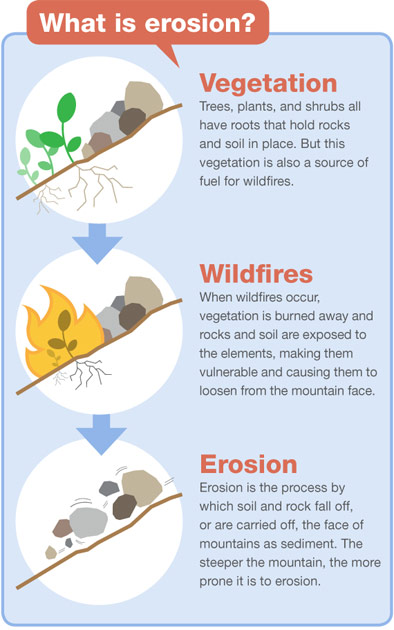
The Los Angeles region is unique because steep, easily erodible mountains are located close to the coast. Erosion occurs when loose soil, rocks, and debris—collectively called “sediment”—are carried downstream, typically during rainfall events. Although Los Angeles receives rain periodically, when storms do occur, they can be intense and produce significant runoff.
Wildfires, which are increasingly common in the Los Angeles region, significantly increase the amount of sediment that erodes and flows from the mountains. Following a wildfire, eroded sediment along with fire debris—such as dense ash and charred vegetation—enters the flood control drainage system during rainfall events. The volume of sediment produced depends on the intensity and duration of the rain, as well as the severity of the fire in the burned area. Intense storms in a recently burned watershed can cause catastrophic property damage. The first five years after a fire are the most critical for sediment management. By years four and five, vegetation typically recovers enough to reduce sediment flows to roughly half of the amount immediately following the fire. Complete recovery to pre-fire conditions generally takes about 10 years.
The District manages a flood control system of dams, debris basins, and other drainage infrastructure, which reduces risk of floods and debris flows for downstream communities. Effective sediment management requires the regular removal of sediment that deposits within District facilities.
Our Role:
To reduce flood risk and conserve stormwater runoff while improving water quality, providing recreation opportunities, and enhancing open space where feasible.
Historic Overview
In 1915, the Los Angeles region experienced a disastrous flood that claimed lives and caused severe property damage. To prevent such tragedies in the future, the California State Legislature adopted the Los Angeles County Flood Control Act. The Act established the Los Angeles Flood Control District, empowering it to provide flood risk management, water conservation, and support for recreation and habitat restoration within its boundaries.
The Flood Control District was governed as a separate entity by the Los Angeles County Board of Supervisors until 1985, when its authority was transferred to the Los Angeles County Department of Public Works. The District is responsible for the majority of the County’s drainage infrastructure, which includes the following components:
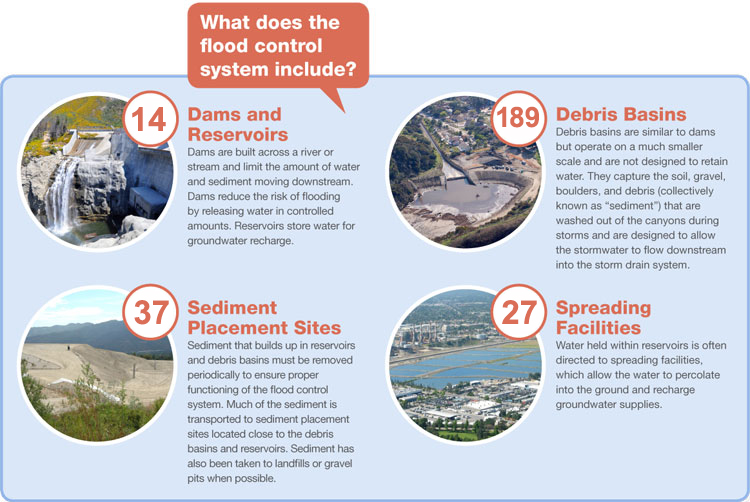
- 14 major dams and reservoirs
- 189 debris basins
- 491 miles of concrete and soft-bottom channels
- 3,400 miles of underground storm drains
- An estimated 97,466 catch basins
- 61 pump plants
- 37 sediment placement sites
- 3 seawater barrier projects
- 27 spreading facilities
How Pubic Works Prepares For Future Storms
The Los Angeles County Department of Public Works operates year-round to ensure that the flood control system, which includes hundreds of miles of open channels and thousands of miles of storm drains, will be ready for future storms. With, inspection and repair is a multi-year process and once its finished its time to start all over again. In addition to inspections and repairs, there is the day to day maintenance of the facilities which includes tree trimming/removal, right of way clearing, fence repairs and weed abatement to name a few.
One of the major maintenance activities is debris basin clean-outs. These operations require several pieces of heavy equipment and hundreds of man-hours in order to ensure all Public Works’ debris basins maintain optimal capacity, thus providing the necessary flood and debris protection to downstream residents.
Debris basin clean-outs generate a tremendous amount of sediment, which must be properly stored. Public Works has developed numerous sediment placement sites (SPSs) throughout the County to address this need. Primarily located adjacent to debris basins, in order to reduce haul distances, these facilities make it possible for Public Works to quickly remove debris from its basins. This is necessary to provide the flood protection to downstream properties in the event of emergency. Over the years, these SPSs have become surrounded by urban. In some cases, homes and businesses surround the SPS, which creates some temporary annoyances for local residents when the SPSs are in operation, such as increased truck traffic, increased dust and noise to name a few. However, these annoyances are necessary to ensure debris basin capacities are maintained.
In addition to Public Works’ staff, contract vendors are also utilized to conduct right of way clearing, trash removal, hazardous waste removal, tree trimming, vacuuming and jetting, street sweeping, slope mowing, etc.
All these efforts ensure that when the next storm hits the Southern California Area, Public Works’ flood control system will work properly and convey storm waters away from developed areas.